
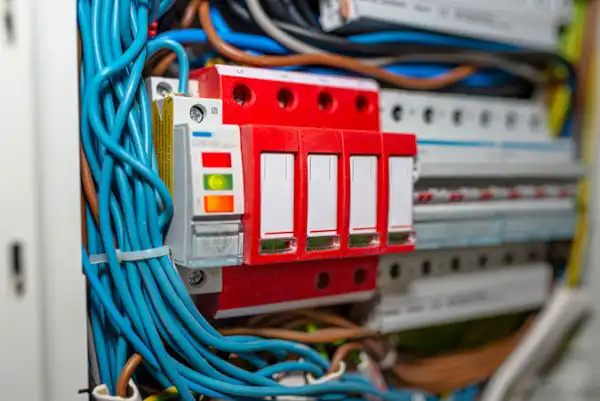
Utah’s summer storms bring lightning and power surges, and most surges never come from a direct strike. Learn how whole-house surge protection works, what it protects, and why installing before monsoon season matters.
Anyone who has spent a July afternoon in northern Utah knows the pattern. The morning is bright and dry, the heat builds all day, and then sometime after 3pm the clouds stack up over the Wasatch and you get thunder rolling down the canyons. Sometimes rain follows. Sometimes it’s mostly lightning and wind.
Those storms are hard on the power grid, and they’re hard on everything plugged into it inside your house.
Here’s the part most homeowners get wrong though. Lightning gets all the attention, and it deserves some. But the majority of the surges hitting your electronics have nothing to do with a storm at all. They’re small, they happen constantly, and they come from inside your own home. Understanding that changes how you think about protecting the place.
Black Diamond has been Utah’s go-to team for home services for years, and we’re licensed for both electrical and plumbing work. Here’s what a whole-house surge protector actually does, and why getting one in before storm season peaks is the smart play.
What Does a Whole-House Surge Protector Actually Do?
A whole-house surge protector installs at your electrical panel and acts as a gatekeeper for everything downstream. When it senses voltage above what your home’s wiring should carry, it diverts that excess energy safely to ground instead of letting it travel out to your outlets, appliances, and electronics.
A few things worth understanding about how they work.
- Where does it get installed? At or beside your main electrical panel, which is why it protects the whole house rather than one room. Because it ties directly into your panel, this is licensed electrical work and not a do-it-yourself project. Getting it wrong creates a hazard rather than removing one.
- Does it stop every surge? No, and any electrician who tells you otherwise is overselling. A whole-house unit handles the large external surges that come in off the utility line, which are the ones capable of destroying equipment outright. Smaller surges that get past it are what point-of-use protection is for.
- Do they wear out? They do. Surge protectors absorb energy over their lifetime, and each event uses some of that capacity up. Most have an indicator light showing whether they’re still providing protection. After a significant nearby strike, it’s worth having yours checked rather than assuming it survived.
- Will I notice it working? Almost never, and that’s the point. A surge protector doing its job is completely invisible. What you notice is the absence of a failed furnace control board or a dead television after a storm rolls through the valley.
Why Do Northern Utah Homes Need This More Than You’d Think?
Our summer monsoon pattern brings frequent thunderstorms and dry lightning to the Wasatch Front from roughly July into September, and lightning is only part of the picture. Canyon wind events, utility switching, and heavy summer grid demand all produce voltage irregularities that reach your home.
Here’s what stacks up against a home along the Wasatch Front.
- Lightning doesn’t need to hit your house. This surprises people. A strike a few hundred yards away can induce a surge that travels into your home through power lines, phone lines, or even underground. Your roof being untouched doesn’t mean your electronics were.
- Canyon winds knock out power, and restoration causes surges. Communities along the benches and near canyon mouths know how hard the wind can blow through here. Downed lines and faults cause outages, and the moment power comes back is itself a common surge event. If you’ve ever had something fail right when the lights came back on, that’s why.
- Summer grid demand is at its peak. When air conditioners across the valley run all afternoon, utility equipment works harder, and switching operations and load shifts produce voltage fluctuations. Storm season and peak demand season are the same season here, which is exactly why this is a spring and early summer project.
- Most surges are made in your own home. This is the one nobody expects. Large motors cycling on and off, your air conditioner compressor, a well pump, the refrigerator, generate small surges dozens of times a day. Individually they’re harmless. Over months and years they quietly degrade sensitive electronics, which is why devices sometimes just fail for no apparent reason.
Isn’t a Power Strip Enough?
Not on its own, no. A surge protector power strip guards whatever is plugged into it, which is genuinely useful for a computer or a television. What it can’t do is protect anything hardwired, and it isn’t built to absorb a large surge arriving from outside your home.
Think of it as two layers doing different jobs. The unit at your panel takes the big hit coming in off the utility line. The strips at your desk handle the smaller stuff that slips past and protect the specific devices sitting on them. Together they cover the house. Either one alone leaves a real gap.
And here’s what a power strip will never help with. Your furnace and air conditioner control boards, your water heater, your dishwasher and washing machine, your garage door opener, your HVAC blower motor, and any smart home equipment wired into the wall. None of that is plugged into a strip, and all of it is expensive to replace.
What’s Actually at Risk in a Modern Utah Home?
A lot more than it would have been 20 years ago. Homes today are full of circuit boards, and circuit boards are exactly what surges damage. Here’s what’s typically on the line.
- Your HVAC system. Modern furnaces, heat pumps, and air conditioners run on electronic control boards, and variable-speed equipment has sensitive inverters and motor controls. A surge that takes out a control board can leave you without cooling in August or heat in January, and the repair is not cheap.
- Major appliances. Refrigerators, ranges, dishwashers, washers, and dryers all rely on electronic controls now. The mechanical parts usually outlive the boards.
- Anything smart. Thermostats, doorbells, cameras, wifi equipment, smart switches, and hubs. Individually inexpensive, collectively a real number, and a genuine hassle to set back up.
- LED lighting. LEDs run on drivers, and drivers are surge-sensitive. Repeated small surges are a common reason LED bulbs and fixtures fail well before their advertised lifespan.
- Solar and EV equipment. Utah has strong solar adoption, and inverters and EV charging equipment represent a significant investment tied directly to your electrical system.
When Should You Install One?
Ideally in spring or early summer, before monsoon season gets going and before peak grid demand arrives. Surge protection only helps against events that happen after it’s installed, so the value is entirely in being early rather than reacting to a storm that already cost you something.
A few situations where it’s worth moving sooner rather than later.
- You’ve already lost something to a surge. If a device has failed after a storm or an outage, treat that as information rather than bad luck. Whatever caused it will happen again.
- You’re upgrading your panel. If electrical work is already planned, adding surge protection at the same time is efficient, since the electrician is working in exactly the right place.
- You’ve added significant equipment. New HVAC system, solar, an EV charger, or a finished basement full of electronics all raise what a single event could cost you.
- Your home is older. Plenty of homes across Salt Lake, Ogden, and Provo were wired long before anyone owned this much sensitive equipment. Older panels are also worth having looked at on their own merits.
- You’re not sure what protection you have. If you can’t remember anyone ever installing surge protection, you almost certainly don’t have it. It’s a quick thing for an electrician to confirm.
What Else Is Worth Checking While an Electrician Is There?
Since surge protection means working at your panel anyway, it’s a sensible moment to have the rest looked over. An electrical safety inspection covers your panel, outlets, and circuits, and it tends to surface things homeowners have been quietly living with.
Worth mentioning to your technician: breakers that trip more than occasionally, outlets or switch plates that feel warm, lights that flicker when the air conditioner starts, any burning smell near the panel, and outlets that no longer hold a plug snugly. None of those are things to ignore, and all of them are easier to address while someone qualified is already in your basement.
Our technicians are certified and background checked before they ever set foot in your home, and you’ll get upfront pricing before any work starts. If we find something, we’ll explain what it is and what your options are rather than handing you a bill and a shrug.
Get Protected Before the Next Storm Rolls Through
Surge protection is one of those investments that’s easy to put off precisely because nothing bad has happened yet. The catch is that it only works going forward. After a strike takes out your furnace board, the cheapest moment to have installed one was last spring.
If you’re not sure what protection your home currently has, or you’d like to get it sorted before monsoon season really gets going, we’re glad to take a look and give you a straight answer.
Black Diamond proudly serves Salt Lake City, Ogden, Layton, Bountiful, Sandy, Draper, Murray, West Jordan, Riverton, Lehi, American Fork, Pleasant Grove, Orem, Provo, Spanish Fork, Park City, Heber, and communities throughout northern Utah. Call (385) 446-1019 or schedule online any time.